


As tremors shook the ground in parts of western Japan last Thursday, local and national government bodies leapt into action.
Meteorologists gathered and issued a temporary tsunami advisory. A special committee warned that another “major earthquake” could hit in the coming week – the first time in its history the body had issued this type of nationwide advisory. High-speed trains slowed down as a precaution, causing travel delays, and the country’s prime minister canceled his overseas trips.
In the end, the government lifted most advisories and reported no major damage from the 7.1-magnitude quake. But much of the country remains on high alert, preparing for a potential emergency during what is normally peak travel season during summer holidays – reflecting Japan’s laser-focus on earthquake preparedness.
However, some experts have cast doubt on whether such an advisory is necessary, or even accurate – and whether it risks pulling resources away from communities deemed lower risk.
Japan is no stranger to severe earthquakes. It lies on the Ring of Fire, an area of intense seismic and volcanic activity on both sides of the Pacific Ocean.
“Japan sits on the boundaries of four tectonic plates, which makes it one of the most earthquake-prone areas in the world,” said Shoichi Yoshioka, a professor at Japan’s Kobe University.
“About 10% of the world’s earthquakes of magnitude 6 or higher occur in or around Japan, so the risk is much higher than in places like Europe or the eastern United States, where earthquakes are rare,” Yoshioka said.
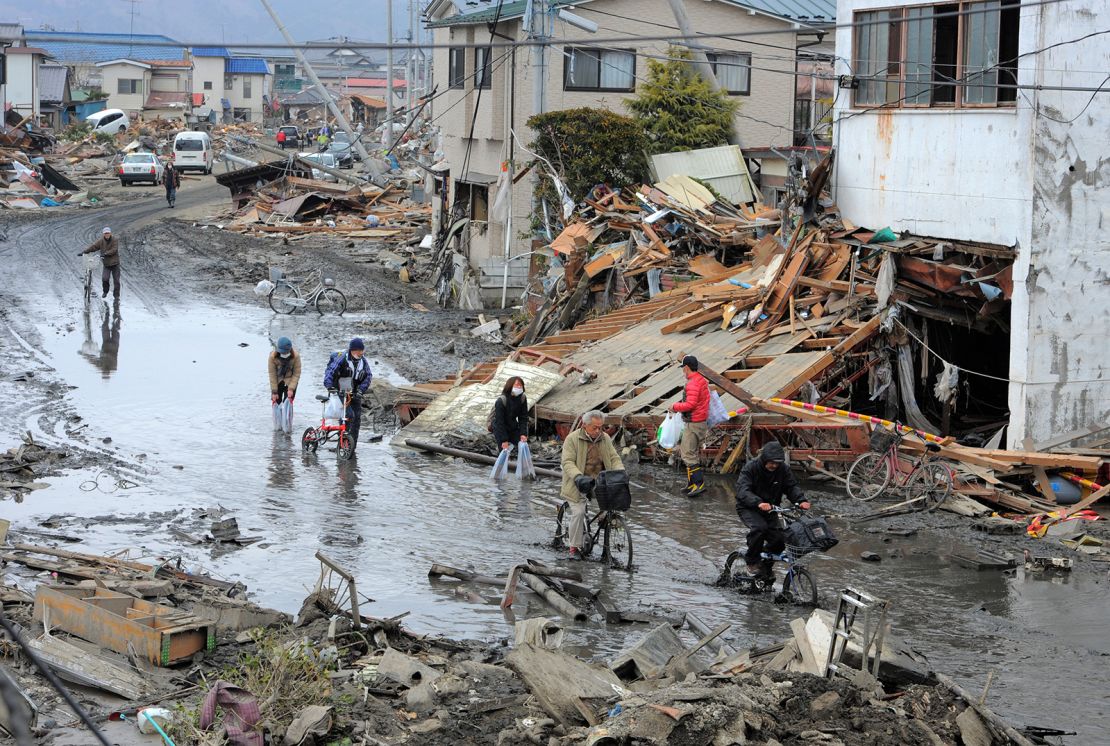
The worst quake in recent Japanese history was the 9.1 magnitude Tohoku earthquake in 2011 that triggered a major tsunami and nuclear disaster. About 20,000 people were killed.
Then there’s the looming threat of the Nankai Trough megathrust earthquake – the most powerful of its kind, with magnitudes that can exceed 9. Seismologists say this could come potentially within a few decades, though the science remains disputed.
Japan’s government has warned of the possible Nankai Trough quake for so many years that the possibility of it occurring has become common knowledge. But it’s also controversial – with some scientists arguing it’s ineffective to focus solely on the slim odds of a hypothetical earthquake in a specific part of Japan, especially when other parts of the country face similar threats but receive far less attention.
The ‘big one’
The Nankai Trough is a 700-kilometer long (435-mile) subduction zone, which refers to when tectonic plates slip beneath each other. Most of the world’s earthquakes and tsunamis are caused by the movements of tectonic plates – and the most powerful often occur in subduction zones.
In this case, the tectonic plate under the Philippine Sea is slowly slipping beneath the continental plate where Japan is located, moving several centimeters each year, according to a 2013 report by the government’s Earthquake Research Committee.
At the Nankai Trough, severe earthquakes have been recorded every 100 to 200 years, according to the committee. The last such quakes took place in 1944 and 1946, both measuring 8.1 in magnitude; they devastated Japan, with at least 2,500 total deaths and thousands more injured, as well as tens of thousands of homes destroyed.
By calculating the intervals between each major quake, the Japanese government has warned there is a 70% to 80% chance that Japan will be rocked by another Nankai Trough earthquake within 30 years, expected to be between magnitude 8 and 9.
But these forecasts, and the utility of even making long-term imprecise predictions, have faced strong pushback from some quarters.
oshioka, from Kobe University, said the 70%-80% figure was likely too high, and that the data drew from one specific theory, making it potentially more prone to errors. However, he had no doubt that “a major earthquake will occur in this area” in the future.
“I tell (my students), the Nankai Trough earthquake will definitely come, whether it’s your generation or your children’s generation,” he said.
Robert Geller, a seismologist and professor emeritus at the University of Tokyo, was more skeptical, calling the Nankai Trough earthquake a “made-up construct” and a “purely hypothetical scenario.”
He also argued that earthquakes don’t occur in cycles, but can take place at any place and time – meaning there’s little point calculating when the next quake will come based on when previous ones have occurred.
It’s a point of contention in the scientific community; seismologists have long relied on the idea that stress accumulates slowly along a fault between two tectonic plates, then is suddenly released in earthquakes, a cycle known as the “stick-slip” process – though more recent studies have shown that’s not always the case.
Even if there is a potential threat on the horizon, the odds are extremely low, with both Yoshioka and Geller calling the public safety measures taken in the past week excessive or unnecessary.
It is true that after one earthquake, a second, larger one can follow – which is why authorities issued the unprecedented warning last Thursday, Yoshioka said. But even then, the probability of the Nankai Trough earthquake happening the next day is low – perhaps increasing from the typical risk of one in 1,000 to one in a few hundred. That’s still less than a 1% chance, he said.
The danger of overblowing these low odds is that, “You would be like the boy who cried wolf,” Geller said. “You’d be issuing these warnings of a slightly larger than normal probability over and over and over again, and the public would get tired of you in a big hurry.”